
Resources & Information
Latest Articles
Article Archives
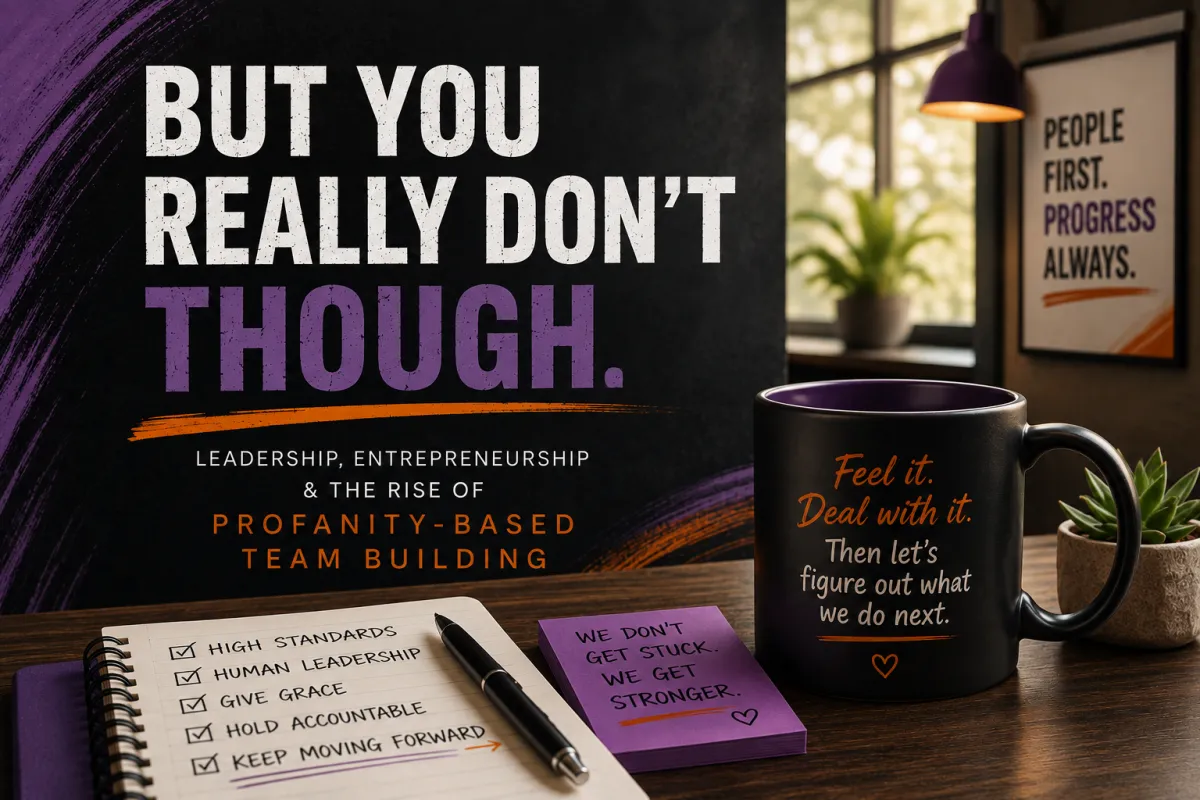
But You Really Don’t Though: Leadership, Entrepreneurship & the Rise of Profanity-Based Team Building
People are always asking me to speak. At networking events. Business groups. Panels. Leadership events. Sometimes they don't just ask. They beg.
And every single time, there is a tiny voice in my head saying:
But you really don't, though.
Because I don't think they want the REAL version of what I think about leadership, entrepreneurship, company culture, marketing, or building a business. They want the conference version. The polished version. The version where I stand behind a podium and say things like synergy, empowerment, company values, and leveraging our collective strengths while everyone politely nods and waits for lunch.
I don't have that version.
What I do have is a team that recently turned "Fuck Off Friday" into what can only be described as an enthusiastic office-wide chant. And you know what?
I'm pretty damn proud of that.
Welcome to Profanity-Based Team Building
To be clear, I don't believe dropping an F-bomb automatically makes someone an effective leader. If it did, half the internet would be running Fortune 500 companies. But I do believe something interesting happens when people feel comfortable enough at work to be human.
We laugh.
We tease each other.
We admit when we're frustrated.
We celebrate together.
We occasionally walk through the office declaring that Friday, in its entirety, can fuck right off.
And then they get back to work.
That's culture. Not the inspirational quote painted on the conference room wall. Not the carefully worded mission statement somebody wrote six years ago and nobody remembers. Culture is how it feels to be there.
Snark Is Welcome. Asshole Behavior Isn't.
There is an important distinction here. I love snark. A perfectly timed one-liner can break the tension in a room faster than any carefully constructed management speech ever could.
Give me quick wit. Give me sarcasm. Give me the person who can make the entire room laugh when everything has gone sideways. But being funny at someone else's expense isn't culture. It's cruelty with better branding. There is no room for that in my building.
Snark punches at the absurdity. Assholes punch at people.
We can joke with each other because there is respect underneath it. That's the foundation. If people have to wonder whether they're the joke, you've lost the thing that makes humor powerful in the first place. A workplace can be irreverent, sarcastic, loud, weird, occasionally wildly inappropriate, and still be incredibly kind.
In fact, I think the humor works because people know they're safe inside it.
Professionalism Isn't a Personality
Somewhere along the way, business decided "professional" meant removing every recognizable trace of humanity. We created an entire language nobody actually speaks.
"Let's circle back."
"I'll take that offline."
"We're looking for opportunities to optimize the process."
Sometimes what we really mean is:
"This isn't working. Who has an idea?"
And somehow we've convinced ourselves the first version is more professional. I disagree. You can communicate directly and still be kind. You can have boundaries and still have a sense of humor. You can expect exceptional work without expecting people to behave like corporate robots for eight hours a day.
And yes, you can say "fuck" and still know what you're doing. Those things are not mutually exclusive.
Your Team Already Knows You're Human
This is one of the strangest things about leadership. We sometimes think we're supposed to become a different species once people report to us. Suddenly we're expected to have all the answers, never get frustrated, never doubt ourselves, and deliver motivational wisdom before our second cup of coffee.
That's ridiculous.
Your team knows you're human. They know when you're stressed. They know when something has gone sideways. They definitely know when a client email has caused your soul to temporarily leave your body. Pretending otherwise doesn't make you look stronger. It just creates distance.
There is enormous value in being the kind of leader who can say:
"Well, that went to shit. Let's figure out what we're going to do about it."
Because the important part isn't "that went to shit." The important part is: "Let's figure it out.
That's leadership.
You Are Allowed to Have a Bad Day Here
I've been yelled at. I've been cried on. I've been vented to. I've sat with people who were angry, overwhelmed, hurt, frustrated, scared, or simply having one of those days when life decided to pile everything into the same 24 hours. And I've giggled with those same people until we couldn't breathe. I love all of it.
Because leadership, at least the way I see it, isn't about managing productivity while pretending the humans producing it don't have lives. If you need a shoulder, I can be the shoulder. If you need a sounding board, I'm listening. If you need to vent, pull up a chair. If you need to cry, cry. If you're pissed off, be pissed off. And when something becomes so completely ridiculous that all we can do is laugh about it? We'll do that too.
But we are not building a house there.
I will sit beside someone in a bad place. I will not help them make it their permanent address. Eventually, we're going to ask: "Okay. What do we do next?"
Not because what happened didn't matter. Not because you're supposed to magically stop feeling it. Not because leaders should tell people to "get over it." Because I care enough about the people around me to help them move through something, not leave them trapped inside it.
We Don't Have to Stop Crying Before We Start Driving
This may be one of the most important things I've learned about moving forward:
You don't have to stop crying before you start driving.
Cry about it. Get mad about it. Talk about it. Laugh about it when you're ready. Hell, you can still be furious while we're figuring out what comes next. But we're moving.
And eventually, if you look in the rearview mirror, you'll notice something. The thing that felt enormous when it was sitting directly in front of you? It's getting smaller. That's what forward motion does.
You don't have to pretend something didn't hurt in order to leave it behind. You don't have to deny what happened. You don't even have to be completely okay yet. You just have to stop letting it determine where you're going.
Sometimes leadership means showing someone the road ahead while they're still looking in the rearview mirror. And sometimes it means reminding them: We're already fucking moving.
Psychological Safety Doesn't Have to Sound Like a TED Talk
There is plenty of research and discussion around psychological safety in the workplace, and it matters. People need to feel safe asking questions. They need to be able to disagree. They need to tell you when they screwed something up before that tiny screwup grows teeth and starts eating the company.
But creating that environment doesn't necessarily require another workshop. Sometimes it starts much smaller. Laughing together. Being approachable. Admitting your own mistakes. Not humiliating someone when something goes wrong. Making it clear that asking for help isn't weakness. Letting people have personalities. Giving someone space to have a terrible day without deciding they're a terrible employee. And perhaps, depending on your particular organizational culture, the occasional communal profanity.
When people aren't spending half their energy performing professionalism, they have a lot more energy available for actually doing great work.
Compassion and Accountability Are Not Opposites
This one matters. Being compassionate doesn't mean abandoning expectations. Supporting someone doesn't mean agreeing with everything they say. Understanding why something happened doesn't mean pretending it didn't happen. You can care deeply about someone and still hold them accountable.
In fact, sometimes accountability is caring. There are moments when someone needs you to say:
"I understand why you're here. But I'm not going to let you stay here."
That isn't cold leadership. That's refusing to confuse empathy with helplessness. I don't want people around me believing they have no power over what happens next. Maybe you couldn't control what happened. Maybe somebody treated you terribly. Maybe you failed. Maybe life simply handed you something spectacularly unfair. Feel whatever you need to feel about that. Then let's figure out what belongs to us now.
What can we change? What can we learn? What can we fix? What can we never allow to happen again? And what do we need to leave in the rearview mirror? That's where the power comes back.
Authenticity Has Become a Very Strange Buzzword
Every brand wants to be authentic. Every company wants authentic leadership. Every audience supposedly craves authenticity. Until somebody actually shows up authentically.
Then suddenly everyone's looking around nervously. "Wait. Not THAT authentic." And that's the funny part.
We say we want real. But we're remarkably attached to polished.
Real businesses can be messy.
Leadership can be messy.
Entrepreneurship is an absolutely bonkers combination of confidence, terror, instinct, spreadsheets, brilliant ideas, terrible ideas, caffeine, stubbornness, and occasionally staring at your computer wondering why the hell you chose this life.
You can pretend otherwise. Or you can build a company where everybody acknowledges the madness and gets on with building something great anyway.
I chose the second one.
High Standards and Humanity Can Occupy the Same Building
This is the part people sometimes misunderstand. A relaxed culture doesn't mean relaxed standards. Having fun doesn't mean you don't take the work seriously. Supporting someone through a hard moment doesn't mean lowering the bar.
I take our clients seriously.
I take our results seriously.
I take deadlines seriously.
I take the responsibility of employing people seriously.
I take how people are treated in my building very seriously.
But I don't believe seriousness has to infect every square inch of the workday. In fact, I think teams often perform better when it doesn't. People who trust each other communicate faster. People who aren't afraid of their boss bring up problems sooner. People who feel valued take ownership. People who know a mistake won't result in humiliation are much more likely to tell you about it while it's still fixable. And people who enjoy the people around them tend to care a little more about what they're building together.
You don't create that by demanding enthusiasm. You create an environment where enthusiasm has somewhere to grow. Sometimes it grows from shared purpose. Sometimes from a huge client win. Sometimes from helping someone through a genuinely terrible day.
And apparently, sometimes it grows from someone declaring "Fuck Off Friday" and accidentally creating an office tradition.
I'll take it.
Build the Company You'd Actually Want to Work For
That's probably the closest thing I have to a leadership philosophy. Build somewhere you'd actually want to work. Hire talented people. Trust them. Teach them what you know. Listen when they know something you don't. Give them room to be good at what they do.
Don't manufacture emergencies. Don't confuse fear with respect. Don't confuse kindness with weakness. Don't make people miserable in the name of professionalism. Let people have bad days. Don't let bad days become identities.
Celebrate the wins. Own the screwups. Protect your people. Hold them accountable. Help them move forward.
Do great fucking work.
And every once in a while, when the week has been particularly determined to test everybody's remaining sanity...
Maybe declare a Fuck Off Friday.
For team-building purposes, obviously.
But Seriously...
There actually is a serious point buried underneath all the profanity. Your company culture isn't something you write.
It's something your people experience.
It's created in hundreds of tiny moments. How you react when someone makes a mistake. Whether people feel heard. Whether laughter is welcome. Whether ideas can come from anywhere. Whether someone can walk into your office on a terrible day and know they don't have to pretend. Whether that same person knows you'll eventually help them find their way forward. Whether employees feel like people or resources. Whether respect travels in every direction, regardless of title.
You don't need to lead like everyone else. You don't need to sand off your personality to become "executive material." And you definitely don't need to turn your business into a sterile corporate machine to prove you're successful.
Build something good. Treat people well. Set high standards. Be yourself. Let them cry. Let them get angry. Let them laugh. Then help them look up.
Because whatever happened?
It's already getting smaller in the rearview mirror.
And if someone asks you to speak about your leadership philosophy someday?
Maybe warn them first.
Because they really don't, though.
Magik Digital believes great businesses don't have to look, sound, or think like everyone else. Neither does great marketing.


Call Us: (877) 217 9864
Email Us: info@magikdigital.com

Useful Links
Get Started